Quick Facts
They generally flower in early summer
1
Plant in spring, before flowering, ideally
2
Alpine types needs good light in an sunny, open location
3
Other types prefer shaded and moist sites
4
Trim after flowering
5
Fully hardy
6
Make new plants by cuttings and seed
7

Before you get started
Choosing specialist phlox
The best starting point for choosing these phlox is working out whether you have the right growing conditions; or can adapt what you have to provide them (including growing in containers).
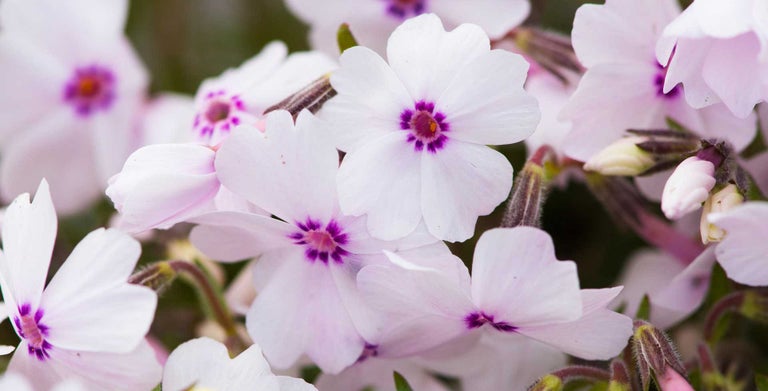
- The majority of these phlox (including Phlox douglasii and Phlox caespitosa) are suited to alpine troughs and rockeries in sunny, free-draining sites. Mostly evergreen and often scented, they have cushion-like, creeping or trailing habits.
- If your site is shaded and moist, choose from another group that are sometimes referred to as ‘woodland phlox’. These too are diminutive plants of around around 7.5-30cm (3in-1ft) tall. They are usually evergreen and often have a creeping in habit, including P. divaricata and P. stolonifera.
Buying specialist phlox
Buy plants from garden centres or mail-order specialist alpine nurseries in spring. Some are available as smaller in spring. Try our Find a Plant search to begin with.
For more information: .
Planting
Planting sun lovers: specialist phlox for rock gardens, alpine banks and troughs
Spring is the best time to plant in a sunny, free draining site.
Choose a potting that is very free draining. You can make your own from equal parts (a ratio of 1:1:1) of loam, horticultural grit, and leafmould.
A top dressing of about 1cm (½in) grit around the base of the plants will set them off decoratively in troughs and rock gardens.
The spacing of plants is dependent on size and habit – they may be mound forming, creeping or trailing – so check the plant's spread on the label position so that the plants won't grow into each other.
Planting shade lovers: specialist phlox for light shade and moisture retentive sites
Spring is the best time to plant in a moist but well-drained soil. Choose a position in dappled shade and space according to spread of the plants, usually 20-30cm (8in-1ft).
Several of these phlox need acidic conditions, so if you don't have acidic soil, they can be grown in containers with peat-free compost with added horticultural grit.
Ongoing Care
Routine care for sun loving specialist phlox
A dressing of about 1cm (½in) of horticultural grit over the surface of the soil with show off plants well and help improve drainage around the base of the stems. This may need topping up annually or weeding as they appear from spring to autumn. Remove fallen leaves and debris from in and around the plants in autumn and winter to prevent them being smoothered.
Routine care for shade-loving phlox
A 1cm (½in) of composted will make sure soil doesn’t dry out in hot weather. Remove fallen leaves and debris from in and around the plants in autumn and winter to prevent them being smoothered.
Pruning and Training
Plants benefit from a trim over after flowering to keep them compact. Otherwise, no other pruning is required.
Propagating
Make more plants of these phlox species and cultivars by taking from non-flowering shoots in early spring (basal stem cuttings) and late spring (softwood stem-tip cuttings). Softwood stem-tip cuttings work best for clump forming plants.
Species can also be grown from seed in spring or autumn and should flower in their second year.
Problems
You may need to look out for rotting stems and leaves in winter, particularly if the soil conditions are not free-draining enough for sun lovers. Look out for puddles of rainwater on the soil surface or browning, dead patches on plants. Conversely check and water plants that like moist conditions so they do not suffer in dry spells.